
03 | Early Childhood Education
Young children are more sensitive to their physical environment than adults, and that sensitivity extends to something most classrooms never consider: light. Human Comfort Lab designs early-childhood spaces around the science of circadian rhythm, not just square footage and daylight views.
The Transition: From daylighting as a code requirement to daylighting as a deliberate tool for a developing nervous system.
Sensory Strategy
Specialized cells in the retina detect light and signal the brain's master clock, which governs sleep, alertness, and a wide range of physiological processes.
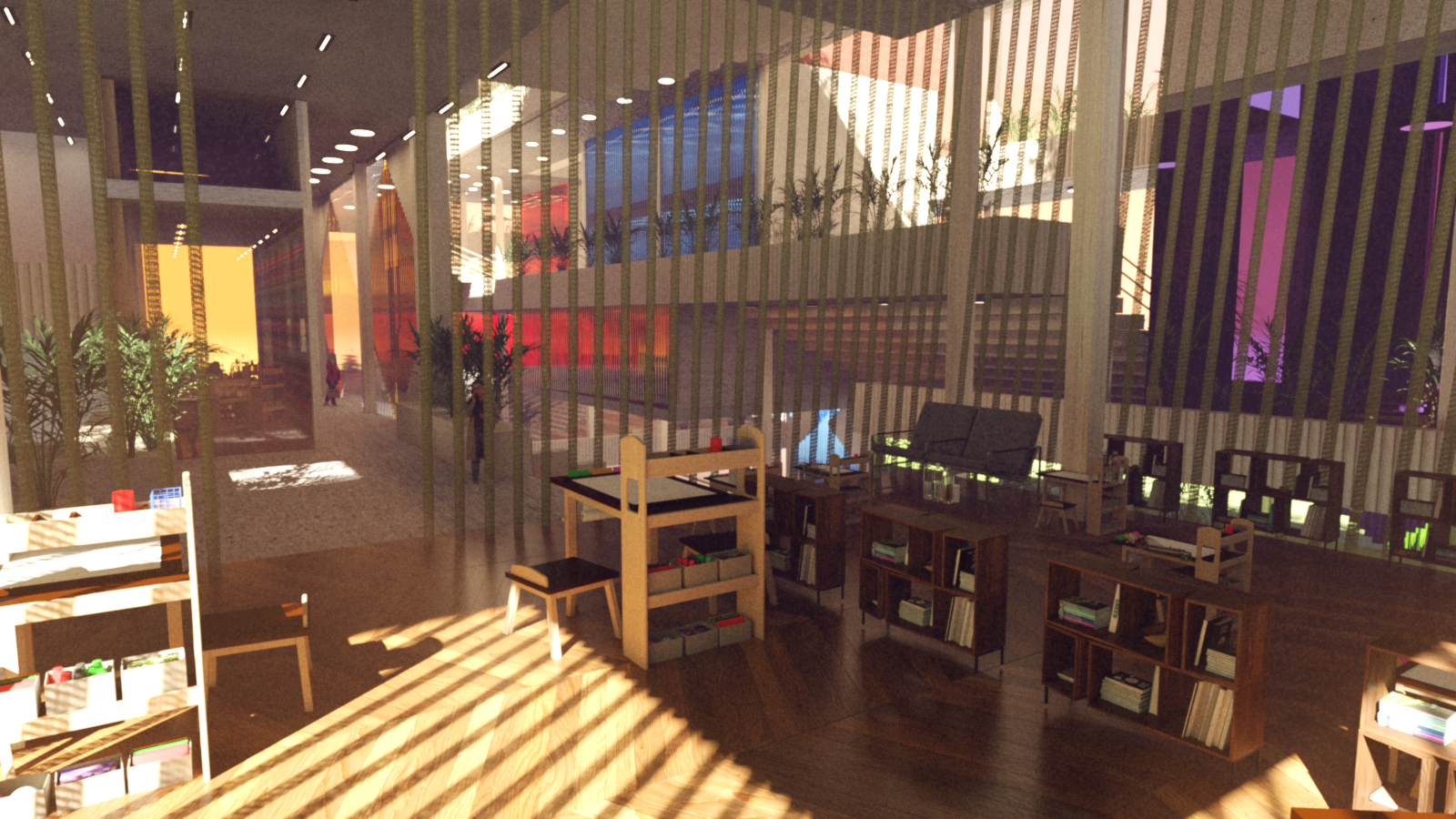
Brighter, cooler light supports alertness during active hours, while warm, dim light supports rest and recovery. This effect is even more pronounced in young children, who show greater sensitivity to circadian disruption than adults, which makes deliberate lighting design especially important in early-childhood spaces.
Territoriality matters just as much. Research on classroom design finds that rigid, undifferentiated spaces push children toward territorial conflict, "you can't come in here," while smaller, clearly bounded areas with movable furniture let children set their own boundaries and reduce that friction. A well-known multi-level study of primary classrooms (the Clever Classrooms research, Barrett et al.) found that a sense of ownership and personalization was one of the strongest design factors linked to children's learning progress.
Material selection carries its own signal. The same haptic response that distinguishes natural materials from synthetic ones applies here: children read stone, wood, and wool as calmer and more trustworthy than uniform plastic and laminate, and that reading shapes how safe and cared-for a space feels to them.
Proximity, how close activity zones sit to each other and to a supervising adult, is its own design variable. Foundational proxemics research (Hall, 1966) established that people, including children, read physical distance as a social signal; in early-childhood spaces, that means zones need enough separation to prevent overstimulation, while staying close enough for a teacher's presence to register as security rather than surveillance.