
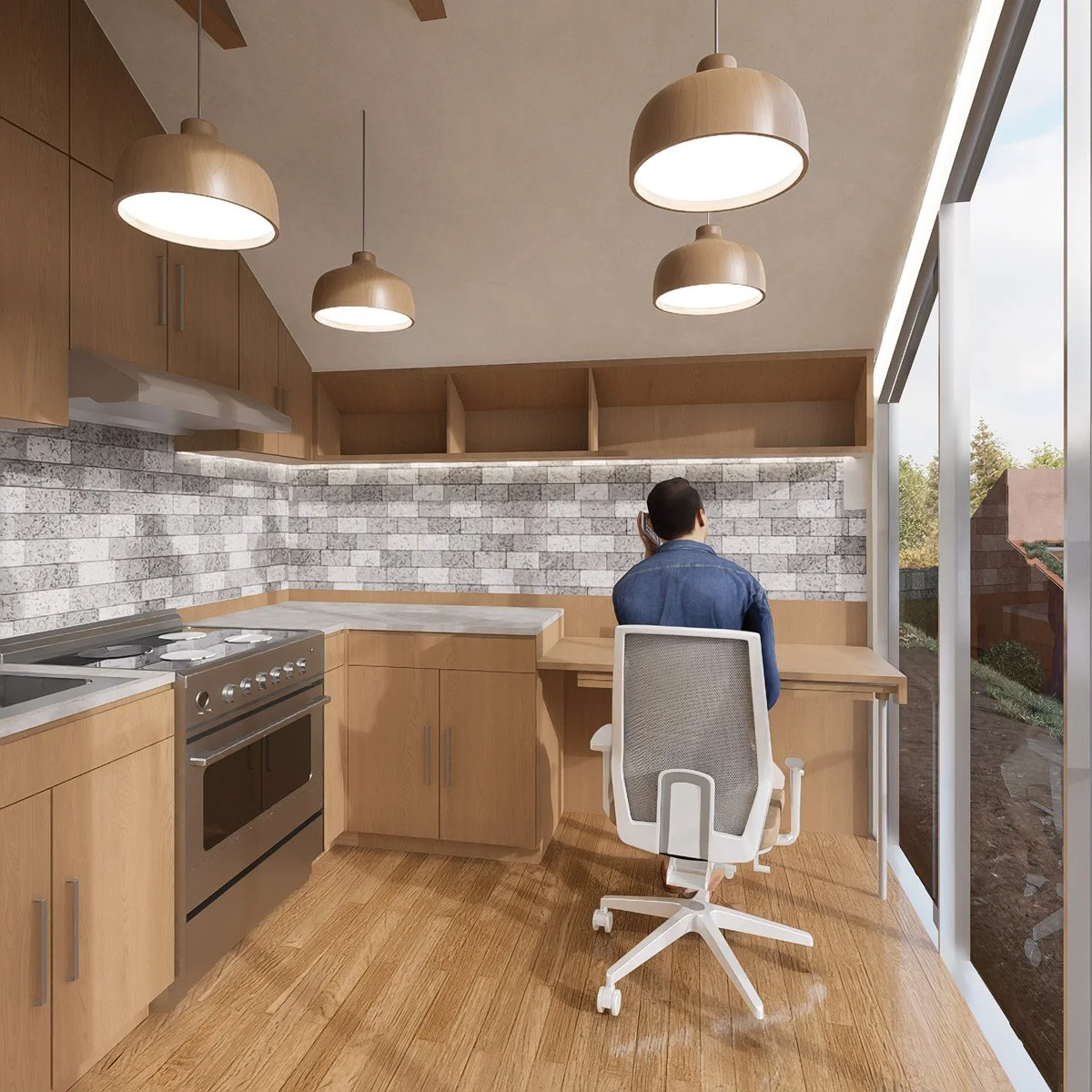
Much of what a Passive House does for the people inside it happens out of sight: a continuous ventilation system working behind an airtight shell.
The System
Mechanical ventilation with heat recovery, known as MVHR, continuously brings filtered outdoor air into a home and exhausts stale indoor air, passing heat from one stream to the other. In a Passive House it is paired with an airtight, thermally unbroken envelope. Our approach is that this removes variability by design: in a conventional home, CO2 can climb overnight and temperature swings with the weather and with heating and cooling cycles, because ventilation and heating are intermittent rather than continuous.
The Research
The clearest evidence on air quality and thinking comes from a controlled study at Harvard (Allen et al., 2016), in which 24 office workers spent full days in simulated office conditions. Cognitive scores were 61 percent higher on the Green building day and 101 percent higher on the two Green+ days, which had higher outdoor ventilation, than on the Conventional day. When researchers raised CO2 on its own, independent of ventilation, scores were about 15 percent lower at roughly 945 ppm and about 50 percent lower at roughly 1,400 ppm than on the Green+ days.
The study is small, short-term, and took place in a simulated office, not a home, so it shows what is possible rather than what every household will experience. Its practical message is that CO2 at typical indoor levels was long assumed to be harmless, and may not be.
In Practice
ARCNOMA applies this thinking to Passive House residences, illustrated on the site by the Microhome. The building envelope is treated as the primary comfort intervention: continuous, filtered MVHR to keep CO2 and particulate levels low and steady, and continuous insulation with the removal of thermal bridging to eliminate the cold spots and drafts that make the body keep adjusting to its surroundings.
Why It Matters
A Passive House is usually sold on its energy bill. The research above suggests a second case: air that stays fresh may matter for how well people think at home. That is an inference from office research, not a guarantee for every home, but it is a reason to judge a Passive House by how it feels and performs for the people inside, not only by its energy savings.